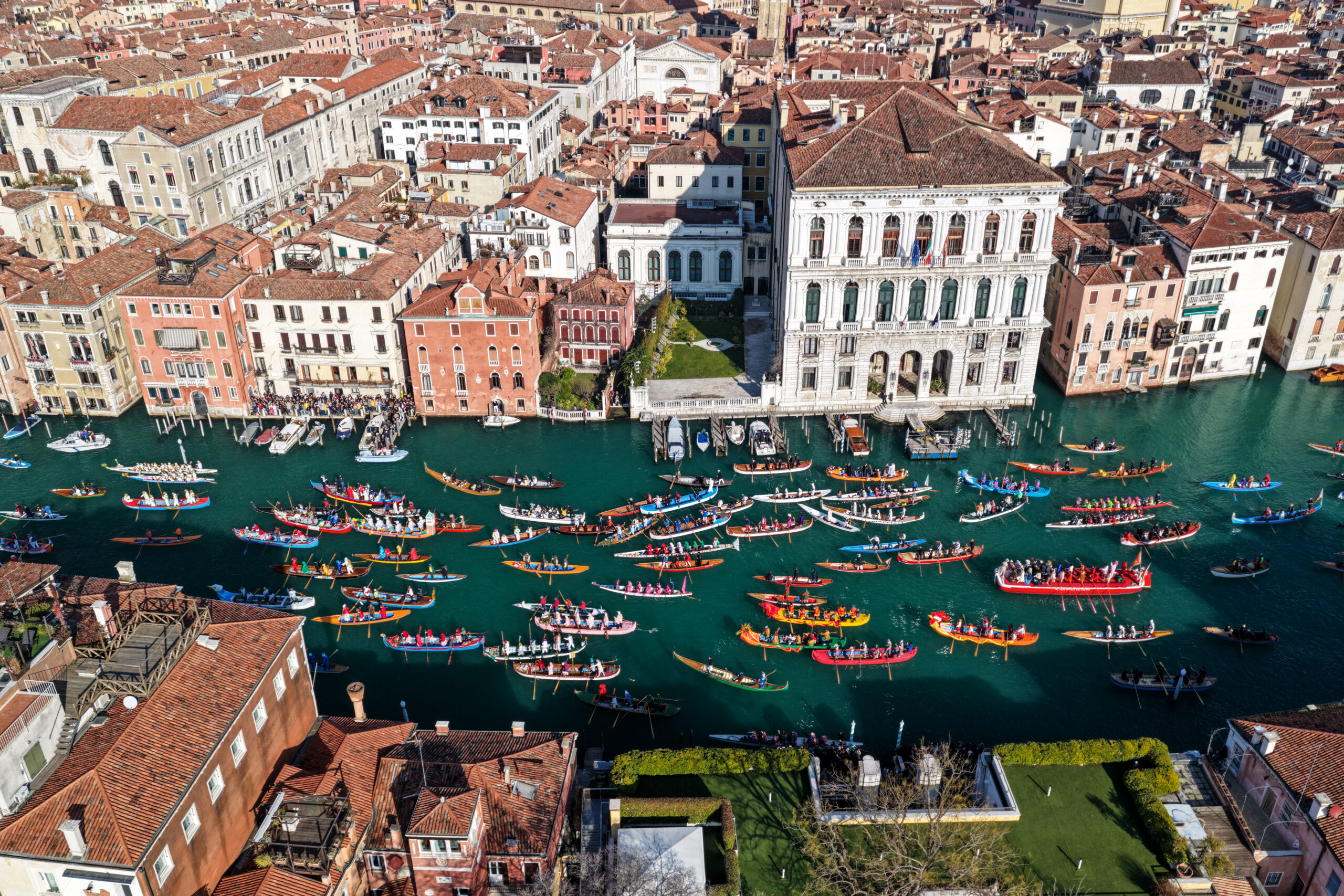
Being a Mover means moving through places while allowing yourself to be moved by them in return. It means not simply observing, but entering the rhythm of what unfolds. In Venice, during Carnival, this sensation becomes tangible. The city vibrates with presences, footsteps, with glances crossing behind a mask.
Walking between Piazza San Marco and the narrow calli, you discover that Carnival is not an event to be watched from a distance. It’s an experience that involves and transforms. Masks are not mere costumes: they charge the body with meaning, alter posture, rewrite the identity of the wearer. Every figure crossing the city becomes a character.
This year’s theme, Olympus – At the Origins of the Games, finds its deepest meaning precisely in movement. The reference to Olympus recalls mythology, but above all an ancient idea of balance between mind and body. Venice has known this harmony for centuries. During the Serenissima, Carnival was a great stage for feats of skill, acrobatic performances, collective challenges. Today, that spirit re-emerges in the city’s natural ability to take part in the scene, turning every gesture and movement of the body into part of a shared narrative.
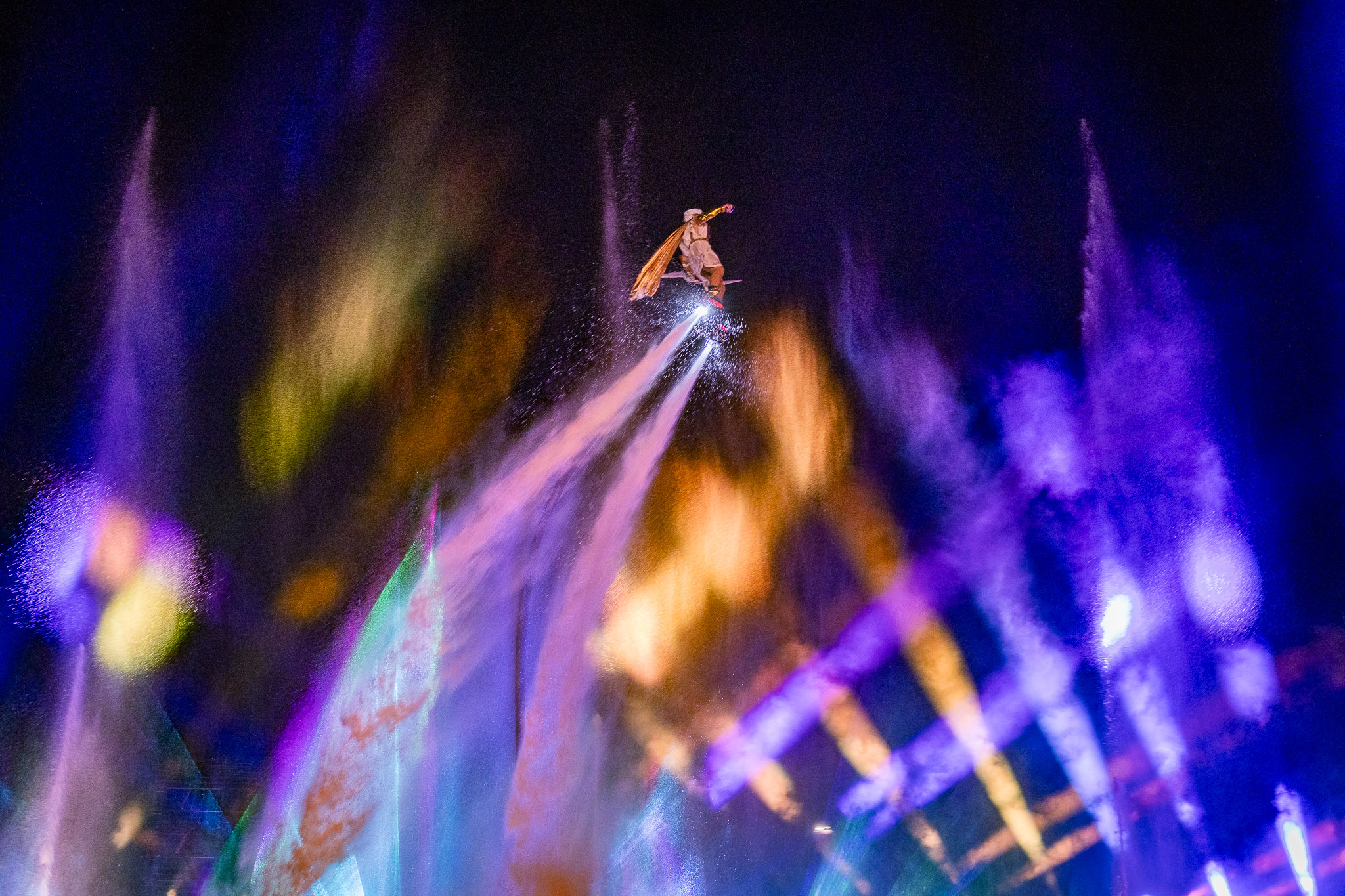
In Venice, water becomes the protagonist. At the Arsenale, in the Darsena Grande, The Call of Olympia comes to life: one of the most evocative performances of this edition.
At the heart of the story is Alvise, a Venetian fisherman. An ordinary man, bound to the sea and its rhythms, who dreams of overcoming his mortal condition to draw closer to the gods. To do so, he must face five trials: Earth, Water, Fire, Air and Ether. The voice of Olympus guides him, calling from above.
Water becomes the true stage. Lights, music and performance create an immersive narrative that transforms the Darsena into a theatre. It is not a show to observe passively. It’s an invitation to recognise oneself in that tension towards something greater. An experience to be fully embraced when in the lagoon during these days.
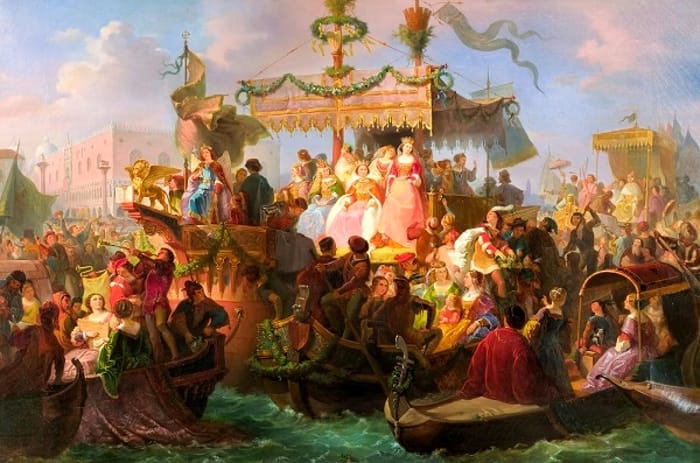
Among the most authentic moments of Carnival is the Feast of the Marys, a ritual that preserves the city’s popular soul. Its origins date back to the 9th century, when twelve young Venetian women received their wedding blessing in the Church of San Pietro di Castello. The community contributed to their dowries, kept in precious wooden chests, in a gesture that combined solidarity and public prestige.
According to tradition, during one of these celebrations a group of pirates from Dalmatia stormed the city and abducted the young women along with their dowries. The community’s reaction was immediate: led by the Doge, the Venetians pursued the aggressors, reached them and freed the girls. Suspended between history and legend, the episode became a symbol of protection, belonging and civic pride.
Today, the Feast of the Marys renews that memory. Twelve young women, coming from Venetian and neighboring municipalities, cross Venice wearing garments inspired by masterpieces by Titian, created by Atelier Pietro Longhi. It is not merely a historical re-enactment. It’s a collective gesture that restores centrality to artisanal tradition and to the symbolic value of the body on stage.
The culminating moment is the proclamation of the Mary of the Year, held in the Sale Apollinee of Teatro La Fenice on 16 February. An occasion worth experiencing when in the area, becoming part of a ritual that unites past and present.
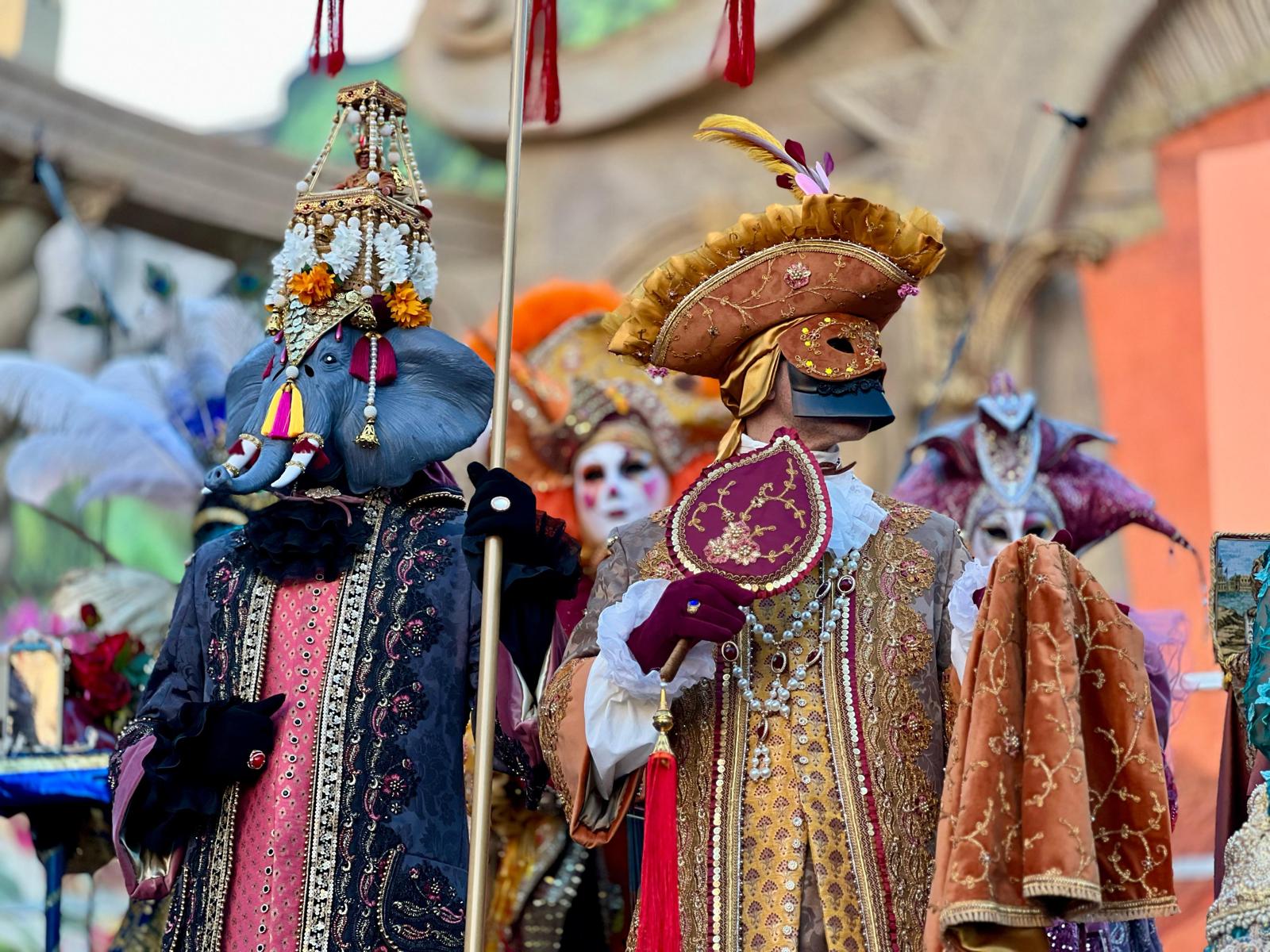
In Piazza San Marco, the contest for The Most Beautiful Mask restores Carnival’s most creative dimension. Participants from Italy and abroad parade after months of work, historical research and meticulous attention to detail.
There are 18th-century costumes rich in brocades and imposing headdresses, visionary contemporary interpretations, creations inspired by the Olympic theme that translate the idea of challenge and harmony into aesthetic form.
The final event, scheduled for 15 February in Piazza San Marco, is one of the most anticipated moments. It is not merely about crowning a winner. It’s the celebration of an international community that recognises in Venetian tradition a shared ground for expression.
Carnival is the art of making visible what often remains hidden: the desire to belong, the will to participate, the need to share a collective space and moment.
For those staying at Move Hotels, Venice during this period is an unmissable destination. Reaching the lagoon means stepping into a narrative that renews itself every year, never truly repeating. It means choosing to experience the city in its most expressive form, when the boundary between observer and participant becomes subtle.
Every collective moment needs bodies to inhabit it. And Carnival reminds us of this with strength: movement is not merely displacement, it is transformation. Thus the territory comes alive, revealing its most authentic energy.